
The Narrative
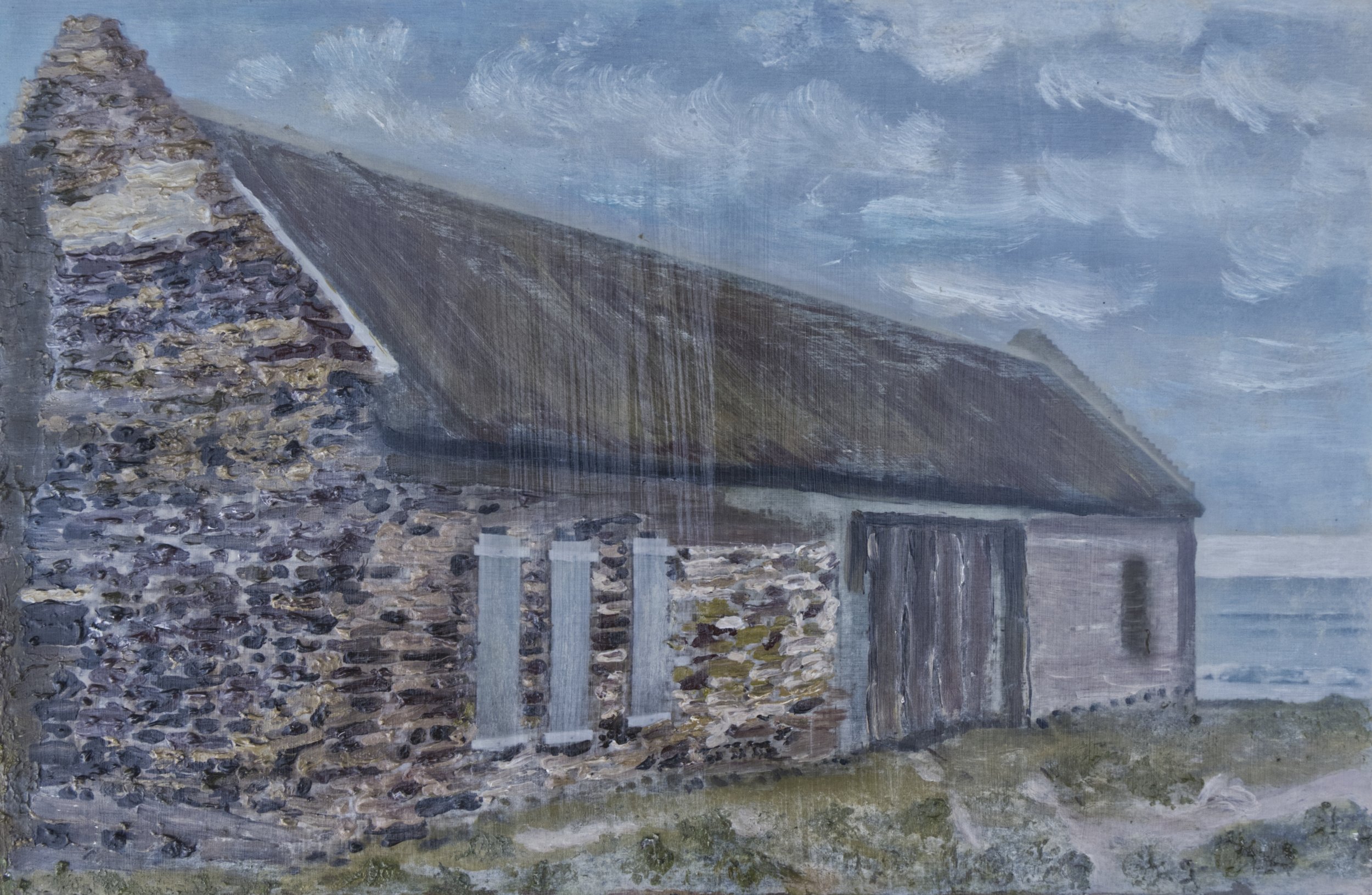
What stories do these silent walls hold? Whether once a family home or a sacred church, this abandoned structure now stands in a heavy, ghostly silence. Its large wooden windows are tightly closed, their colors faded by the passage of time. Yet, amidst the decay, the elongated shape of the brick walls draws a sharp, upward perspective—a defiant architectural stand that suggests a lingering sense of hope.
The Technique
Method: Image transfer onto a metallic i-Bond sheet with heavy, sculptural acrylic coats.
Color Palette: A grounded earth-tone map of ochre, sienna, and deep browns. Cream and white highlights are applied to catch the light on the brick edges, while hand-applied blacks and browns mimic the faded patina of time.
The Feel: This piece feels structural and rhythmic. The metallic base provides a steady, industrial glow that contrasts with the organic, matte textures of the hand-painted grass and weathered brick.
While a traditional photograph lives on paper, Behind the Bricks is an exploration of architectural weight. The metallic i-Bond sheet provides a rigid, permanent foundation that echoes the strength of the original walls. As light moves across the room, it catches the sculpted ridges of the individual bricks, making the perspective "pull" the viewer’s eye upward, just as the artist intended.
This is not a digital reproduction; it is a physical reconstruction. Grace Remondo has used her fingers to apply deep browns and blacks, literally "weathering" the image to reflect the passage of time. By building up heavy coats of acrylic, she has transformed a flat photograph of a wall into a tactile, three-dimensional surface. This manual intervention bridges the gap between the "huge silence" of the past and the physical "hope" of the present.
SHIPPING & CARE
International: Tracked & Insured via premium courier.
Packaging: Shipped in eco-friendly, rigid protective packaging.
Artist’s Note: Each piece is hand-finished. Please allow 7–10 days for curing in the Cape Town studio before dispatch.
Dimensions: 18×13×2 in
The Narrative
What stories do these silent walls hold? Whether once a family home or a sacred church, this abandoned structure now stands in a heavy, ghostly silence. Its large wooden windows are tightly closed, their colors faded by the passage of time. Yet, amidst the decay, the elongated shape of the brick walls draws a sharp, upward perspective—a defiant architectural stand that suggests a lingering sense of hope.
The Technique
Method: Image transfer onto a metallic i-Bond sheet with heavy, sculptural acrylic coats.
Color Palette: A grounded earth-tone map of ochre, sienna, and deep browns. Cream and white highlights are applied to catch the light on the brick edges, while hand-applied blacks and browns mimic the faded patina of time.
The Feel: This piece feels structural and rhythmic. The metallic base provides a steady, industrial glow that contrasts with the organic, matte textures of the hand-painted grass and weathered brick.
While a traditional photograph lives on paper, Behind the Bricks is an exploration of architectural weight. The metallic i-Bond sheet provides a rigid, permanent foundation that echoes the strength of the original walls. As light moves across the room, it catches the sculpted ridges of the individual bricks, making the perspective "pull" the viewer’s eye upward, just as the artist intended.
This is not a digital reproduction; it is a physical reconstruction. Grace Remondo has used her fingers to apply deep browns and blacks, literally "weathering" the image to reflect the passage of time. By building up heavy coats of acrylic, she has transformed a flat photograph of a wall into a tactile, three-dimensional surface. This manual intervention bridges the gap between the "huge silence" of the past and the physical "hope" of the present.
SHIPPING & CARE
International: Tracked & Insured via premium courier.
Packaging: Shipped in eco-friendly, rigid protective packaging.
Artist’s Note: Each piece is hand-finished. Please allow 7–10 days for curing in the Cape Town studio before dispatch.
Dimensions: 18×13×2 in